In the video below, professional mountain biker Matt Hunter and some of his closest friends traveled to Afghanistan to ride through Wakhan. They captured their adventure with the new Sony Action Cam and produced an outstanding short film of their experiences. If you're in the mood for a mountain biking adventure, you won't want to miss out on this one.
Showing posts with label Afghanistan. Show all posts
Video: Mountain Biking Afghanistan's Wakhan Corridor
The Wakhan Corridor is a narrow patch of land located in northeast Afghanistan that separates Tajikistan and Pakistan. The Corridor was once used a trade route hundreds of years ago, but as better routes over both land and sea developed, it was all but forgotten. Today it is seldom visited by westerners but by all accounts it is a breathtakingly beautiful and rugged place.
In the video below, professional mountain biker Matt Hunter and some of his closest friends traveled to Afghanistan to ride through Wakhan. They captured their adventure with the new Sony Action Cam and produced an outstanding short film of their experiences. If you're in the mood for a mountain biking adventure, you won't want to miss out on this one.
In the video below, professional mountain biker Matt Hunter and some of his closest friends traveled to Afghanistan to ride through Wakhan. They captured their adventure with the new Sony Action Cam and produced an outstanding short film of their experiences. If you're in the mood for a mountain biking adventure, you won't want to miss out on this one.
Video: EpicTV Interviews Mike Libecki
Explorer and climber Mike Libecki was named a National Geographic Adventurer of the Year for putting up first ascents in Borneo and making first descents on snowboards in Afghanistan. Recently he sat down with the crew over at EpicTV to conduct a video interview of what he has been up to since. In the interview he talks about climbing in Antarctica, Yemen and much, much more. Some of the real highlights of the video are some of his amazing photos from the places he has been. Excellent stuff.
2012 National Geographic Traveler Photo Contest Finalists
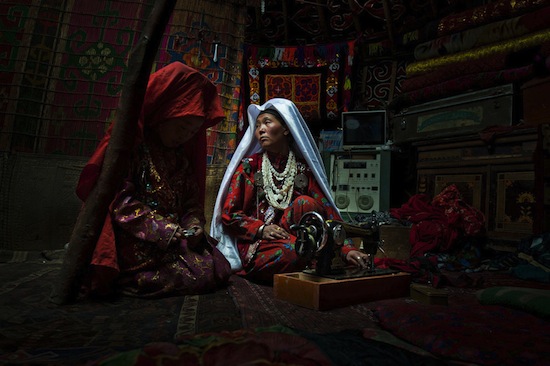 |
| Photo © Cedric Houin-All Rights Reserved |
In Focus, the superlative photo blog of The Atlantic, features the winners of the 2012 National Geographic Traveler Photo Contest in a much more satisfying format than the National Geographic. The finalists' photographs are shown in a 1280 pixel size; a size that will fill the largest monitors.
The winners consist of a group of 10 photos plus one Viewer's Choice winner. These images were chosen from more than 12,000 entries submitted by 6,615 photographers from 152 countries. The winners are from four categories: Travel Portraits, Outdoor Scenes, Sense of Place, and Spontaneous Moments.
First place went to Cedric Houin with the above photograph of the inside of a family yurt in the Kyrgyz lands of the Wakhan Corridor. We are told by the photograph's caption that the tribes living in the area are weeks away from any village by foot, and although located at an altitude of 4,300 meters in one of the most remote areas of Afghanistan, solar panels, satellite dishes and cellphones are prevalent.
It's not often that I agree with results of photography contests, but the judges' choice in this one is spot on. The richness of the reds of the yurt's interior, and the facial expression of the main protagonist along with the smaller details make a story out of that photograph.
It's not often that I agree with results of photography contests, but the judges' choice in this one is spot on. The richness of the reds of the yurt's interior, and the facial expression of the main protagonist along with the smaller details make a story out of that photograph.
Cedric Houin is a French & Canadian documentary photographer, and a visual storyteller.
As for the Wakhan Corridor, it's an area of far north-eastern Afghanistan which forms a land link between Afghanistan and China. It's a long and slender area, roughly 140 miles long and between 10 and 40 miles wide. It also separates Tajikistan in the north from Pakistan in the south.
As for the Wakhan Corridor, it's an area of far north-eastern Afghanistan which forms a land link between Afghanistan and China. It's a long and slender area, roughly 140 miles long and between 10 and 40 miles wide. It also separates Tajikistan in the north from Pakistan in the south.
The 3 Scariest Things I Ever Did On My Travels

For those who think hopping on a plane for a trip to London or Paris or Mexico City is adventurous and dangerous, this post may be hard to relate to. I started hitchhiking across America when I was 13. I hitched from Brooklyn to L.A. when I was 15 and stowed away on ship so I could make a new, simpler life for myself on Tonga. I celebrated my 21st birthday in my home-- a thatch-roofed bungalow steps from the Arabian Sea in Goa. But this morning, after reading about the latest deprecation in war-torn Mali, I tried to recall what the most dangerous stunts I had pulled on my travels.
Because I was swimming when I was thinking about it-- and because I get really scared of crocodiles and alligators-- one that popped into my mind was a trip to Esteros del Iberá a swampy section of northern Argentina where Argentina, Brazil and Paraguay all come together. They call it the Serengeti of Latin America because of the abundance of wildlife and, as I noted at the time, "the most important thing was to get the idea of "swamp" out of my head. This was easy because the place is not only gorgeous, it is fresh and even cooler than everyplace around it. The water is so beautiful that if it weren't for the alligators, pirhanas, capybaras and anacondas, you'd want to jump right in-- as many of the folks who live around there do anyway (and have the missing fingers and toes to prove it)."
Alligators-- they call them Yacare Caiman in the neighborhood, like the fella in the picture-- are something I usually go out of my way to avoid. So, for me, the scariest moment came when I agreed to go with a local in a dugout canoe for an afternoon of caiman, capybara (word's biggest rodent) and anaconda watching. And for hours that's all I saw... not anacondas, just a billion alligators and giant prehistoric rats.
Years earlier I had a run-in with an even scarier creature. I was bumming around Afghanistan in 1969 and found myself captured by a militia up in the mountains. I didn't understand a word of Pashtun at the time-- I learned a few months later when I got snowed in and stranded in a tiny Pashtun village for the winter-- but I sure understood the universal motions and grunts for "put your hands over your head or I'll unload this Kalashnikov into it." So I did. Maybe they wanted to go for a Ripley's Believe It Or Not Record, but they just had us keep our hands over our heads for hours. Eventually some Australian hippie who was with me-- and peaking on acid-- just started laughing and lowered his hands. At first the Afs all started screaming menacingly and made like they were about to shoot us. Then I started laughing and lowered my hands too. And then everyone else did-- and soon we were sitting around the campfire drinking tea with the militia all laughing away and smoking opiated hash like we were all best friends.
Most recently though, Roland and I went to Mali and wound up in Timbuktu on the outskirts of the Sahara Desert. It's not really the outskirts anymore; the desert is encroaching rapidly and the streets get covered in sand all the time. One night we decided to go with Mohammed, our Tuareg guide, into the Sahara itself. It's trackless; there's nothing but sand dunes and the light is the moon and stars and our flashlights. Our destination: a Tuareg encampment a few miles away where some nomads had come down from the desert to trade. We were leaving for America in a few days and there was plenty of stuff to trade-- from my high-end REI walking sticks to cans of sardines Roland had brought... and toilet paper, airline shaving kits, bits and pieces of clothes... all kinds of stuff we didn't want to schlepp back to L.A. It went pretty well. It might not have. As I've been writing in the last few months, a Tuareg rebellion was brewing and it's boiled over... big time. They've seized two-thirds of the country. And these are bad guys; they believe slavery is condoned by their religion, for example. And in the name of their primitive and ignorant concept of Islam, they are destroying Timbuktu, ironically a centuries-old center of Islamic learning.
Armed fighters of Mali's al-Qaida-linked Ansar Dine Islamist group on Saturday destroyed mausoleums in the ancient trading city of Timbuktu, classified as a UNESCO World Heritage site, witnesses said.
The attack came just four days after UNESCO agreed to a request by the West African state to place Timbuktu on its list of heritage sites in danger following the seizure of its northern two-thirds in April by separatist and Islamist rebels.
"They have already completely destroyed the mausoleum of Sidi Mahmoud (Ben Amar) and two others. They said they would continue all day and destroy all 16," local Malian journalist Yeya Tandina said by telephone of the 16 most prized resting grounds of local saints in the town.
"They are armed and have surrounded the sites with pick-up trucks. The population is just looking on helplessly," he said, adding that the Islamists were currently taking pick-axes to the mausoleum of Sidi El Mokhtar, another cherished local saint.
Roland is protesting because I didn't include the time I was stranded on a coral reef in Sri Lanka and the time we almost drove over a cliff in the High Atlas Mountains of Morocco south of Marrakech.
Elissa Bogos: Afghan Tea House Poets
Here's a wonderful short (too short!) video made by Elissa Bogos in a tea house in Afghanistan on 11.11.11 for One Day on Earth."Let all the infidels become Muslims"
I describe it as wonderful, not because of the unfortunate intolerance expressed by the old man towards the end of the clip, but because it's beautifully filmed, because of its ambience and because of the music. I wished the clip had been much longer, and that it tarried longer with the "poets" who recited traditional verses (and expressed their gripes), and that it lingered around the corners of the tea house.
Elissa Bogos is a freelance photojournalist and videojournalist based in Kabul, Afghanistan. She was the editor-in-chief of The Sakhalin Times, an English language weekly in the Russian Far East.
Her photographs and videos were published in The New York Times, BBC, The Guardian, EurasiaNet, The Huffington Post, The Montreal Gazette, Reuters, New York Daily News and in other media. In Afghanistan, she freelances for a variety of NGOs and private companies and has worked with the Associated Press, Tolo TV and Channel One TV.
The Wakhan Corridor
The Wakhan Corridor is a slender area in the far north-eastern Afghanistan which forms a land link between Afghanistan and China. The corridor was a political creation of the Great Game, and a result of agreements between Britain and Russia in 1873 and between Britain and Afghanistan in 1893. It currently has 12,000 inhabitants, who live very much the same as their ancestors did centuries ago.
In 2011, inspired by an article published by the New York Times, Fabrice Nadjari and Varial, two 33 year-old authors, photographers and childhood friends, decided to embark on a journey in the Wakhan region. It is here that they decided to take photographs of the inhabitants of the Wakhan villages. The portraits made with their Polaroid cameras developed odd hues, and their quality deteriorated quite rapidly due to the altitude.
The photographers also produced the Traces of Time book project (to be published in May 2012) which they claim "presents a vision between a current and tangible printed reality that already ceases to exist and an uncertain present resembling the past. This is the perspective of travellers who steal a snapshot of life and leave behind a trace that could change the lives of those they've passed."
As is seen in the trailer (listen to the haunting soundtrack!!) above, the photographers convinced Ismaili children, young women, and housewives, opium smokers, village chiefs and simple peasants to pose for their Polaroid cameras.
The show Wakhan, An Other Afghanistan will be featured at the MILK Gallery, 450 West 15th Street in New York (May 18-23, 2012).
Choo-Choo Trains Finally Coming To Afghanistan?

That's the highway, dangerous and barely functional these days
I drove a shiny new red VW van that I bought in Germany across Europe and Asia to Afghanistan in 1969. What a trip! And Afghanistan was nothing like anything I had ever seen or experienced before. I fell in love with the country. But it wasn't easy to get around. Well, there was a nice, well kept-up paved highway that circumnavigated the perimeter of the roundish-shaped country. I sort of remember that the stretch from Herat in the northwest to Kandahar down south and on to Kabul in the east (and to the Khyber Pass further east into Pakistan) was built by the U.S. and that the other half, from Kabul to Mazar-i-Sharif and the poppy and hash fields up north and on to Herat were built by the Russians. It worked for me-- except for the entire middle of the country which could only be traversed on rutted, mostly dirt, roads... well, barely roads. My van wasn't going anywhere. So I left it in Kabul and went with some friends for a nice ride in the country up to the Hindu Kush. It was supposed to be a 10 day jaunt. I fell off the horse, broken an ankle and spent six months in a "village" with two family compounds. No one had ever experienced electricity or heard of the U.S. and no one could read-- or even speak Farsi, the Afghan language I could get along in. The adventure of a lifetime... but I sure was thinking how nice it would have been if Afghanistan had had a railroad system. (I wasn't the only one thinking along those lines.)
But Afghanistan didn't want a railroad system. From the time of Alexander the Great until a couple years before I drove in with my VW van, few people visited Afghanistan unless they were riding in on horseback with an army. It mostly worked out poorly for everyone. But now, we learn, Afghanistan, who's beautiful highway system has been turned to rubble, like most of the country, is finally building a railroad. China and India are building it-- so they can extract, respectively, copper and iron ore.
More than a century ago, fearing that his country might be swallowed up in the Great Game rivalry between the British empire to the east and the Russian army to the north, an Afghan king made a radical decision: He banned railroads.
That edict effectively kept out foreign troops for a number of years. But it also left the Afghan economy, once a wealthy crossroads of the ancient Silk Road trading routes, largely cut off from the world at a time when trains were the engines of development.
Now, Afghanistan has just opened its first major railroad and is planning a half dozen more. The government is also inviting other countries to build tracks, part of plans for a "New Silk Route" that the U.S. hopes will help stabilize the region by promoting trading links.
China, Iran, Pakistan and India all have government or corporate plans for separate railroad projects across Afghanistan. Turkmenistan is completing its own plans for another line. And Uzbekistan has already built the first major rail link, a 47-mile (75-kilometer) line from the border town of Hairatan to Mazar-i-Sharif in Afghanistan's north.
One reason so many countries are helping Afghanistan belatedly join the rail age: They need trains if their companies hope to export the country's vast, untapped mineral wealth, estimated by U.S. surveys at nearly $1 trillion.
Both the railway projects and the prospects for future mining wealth will depend largely on whether the country can keep violence from escalating once the international military force withdraws most of its troops by the end of 2014. For investors, it's a question of whether the increased commerce is worth the risk and effort.
"Now there is genuine trade and traffic going on, especially in the north of Afghanistan, so it makes sense," says Andrew Grantham, an editor for Railway Gazette who runs a website chronicling the history of Afghanistan's failed railroad projects. "It's not just people drawing lines on maps and saying, "Wouldn't this be nice?"
Competing for contracts to mine deposits of copper, gold, iron and lithium is Afghanistan's modern Great Game, and one of the prices the government is extracting from eager companies is a promise to develop the railroads necessary to carry the heavy cargo.
"This will be critical to get anything to markets," says Juan Miranda, head of Central and West Asia Department of the Asian Development Bank, which funded the $165 million Uzbek-built railroad. The bank is also pushing a plan to link landlocked Afghanistan into the rail networks of all five of its neighbors.
For now, plans for Afghanistan's railroads are progressing bit by bit. As part of its agreement to develop a massive copper mine in Aynak, the China Metallurgical Group Corporation (MCC) is being asked to build a 575-mile (920-kilometer) railway from the mine southeast of Kabul. One branch would head to the Pakistani border, another in the opposite direction through the capital and connecting with the new Hairatan line in the north.
The Afghan government is also negotiating with the Indian-led consortium that won the contract for the equally huge iron deposits at Tajigak in central Afghanistan for the companies to fund a 560-mile (900-kilometer) railroad-- likely through Iran-- to bring out the heavy ore.
The story of how Afghanistan never got a major railroad pivots around Abdur Rahman Khan, the emir who ruled Afghanistan from 1880 to 1901. During his reign, Afghanistan was sandwiched between the British colonial rulers of India, which then encompassed modern-day Pakistan, and the Russian empire that extended into Caucasus areas of Central Asia.
Both sides were engaged in what was known as the Great Game to control the region. They were racing to build railroads in areas under their control as a way of quickly moving troops. By the 1880s, both the British and the Russians had built tracks that went right up to Afghanistan's border.
Rahman Khan responded with a decree that no railroad would be allowed to enter Afghan territory, reasoning that without them, it would be difficult for invading troops to cross the mountainous frontier, according to Grantham.
Afghanistan is "almost unique worldwide" in its history of actively working to stop railroads, Grantham says. "Most countries wanted railways."
In fact, the emir's gambit may have worked: Afghanistan never was annexed by either great power.
"It is one of the factors that probably kept the country together, but the price was Afghanistan became a complete backwater economically," says Fred Starr, chairman of the Central Asia-Caucasus Institute at Johns Hopkins University in Washington.
In the 1920s, Rahman Khan's modern-minded grandson, King Amanullah, planned a modern rail network in Afghanistan and even built 5-mile (8-kilometer) track with steam locomotives running between Kabul and his European-style palace of Darulaman. But his plans for a wider network met with opposition, and the line fell into disrepair after he was overthrown in 1929. The locomotives are now in a Kabul museum, next to Amanullah's bombed-out palace.
...The plan is to build a series of short, cross-border tracks to Uzbekistan, Turkmenistan, Tajikistan, Pakistan and Iran. The tracks would connect to each other inside the country's north by railways built by Iran from the west and China from the east.
"We would be able to import and export to Russia, Turkey, and even European countries," says Noor Gul Mangal, Afghanistan's deputy public works minister. Opening new transport gateways would also reduce Afghanistan's dependance on neighboring Pakistan as its only link to sea ports.
Only one line is finished and several of the rest are delayed or face funding problems. But already, the prospect of restoring Afghanistan's status as the crossroads for goods traveling from India, China and Europe has kindled enthusiasm.
Instead of silk, spices and tea, the New Silk Route would carry washing machines from India, heavy machinery from Europe and T-shirts from Pakistan over interconnecting railroads that are faster than container ships and cheaper than air freight.
Prediction: not in your lifetime, at least not a passenger service-- not with this kind of stuff making foreigners less and less welcome there... and rightfully so.
Western forces shot dead 16 civilians including nine children in southern Kandahar province on Sunday, Afghan officials said, in a rampage that witnesses said was carried out by American soldiers who were laughing and appeared drunk.
One Afghan father who said his children were killed in the shooting spree accused soldiers of later burning the bodies.
Witnesses told Reuters they saw a group of U.S. soldiers arrive at their village in Kandahar's Panjwayi district at around 2 am, enter homes and open fire.
The Afghan Box Camera Project
 |
| Photo Courtesy The Afghan Box Camera |
I was very glad to have stumbled on The Afghan Camera Box Project website a few days ago. For quite a while I had given up on posting anything to do with Afghanistan, since the photographs published in various media were either repetitive, unimaginative, stereotypical or plain silly....but this website touches on culture and photography.
The purpose of the Afghan Box Camera Project is to provide a record of the kamra-e-faoree (which in Dari and also in Arabic means 'instant camera') which as a living form of photography is on the brink of disappearing in Afghanistan. It's one of the last places where photographers continue to use a simple type of "instant camera" to make a living. The hand-made wooden camera is both camera and darkroom, and generations of Afghans have had their portraits taken with it, usually for identity photographs.
The project is the work of Lukas Birk and Sean Foley.
The railway station of the Cairo suburb where I grew up had a wooden camera photographer, and I recall (dimly, I admit) had a brisk business. I also came across a wooden camera photographer in Havana, Cuba who showed me how he developed the photograph he made of me.
Two of my friends, Divya Dugar and Frances Schwabenland have produced work on wooden cameras being used in Jaipur in Rajasthan, while Rodrigo Abd has produced Mayan Queens with a 19th century wooden camera of the indigenous women competing to become the National Indigenous Queen of Guatemala.
Darkness Visible Afghanistan
I occasionally post on projects that I believe ought to be supported by the public at large, and one such project is Darkness Visible Afghanistan by photojournalist Seamus Murphy, whose aim is to raise $10,000 to create a documentary movie based on his many years traveling and photographing in Afghanistan.
"My mission is to promote an understanding of this mysterious, complex and fascinating culture."
Seamus Murphy has been photographing Afghanistan since 1994. He published a book, also titled A Darkness Visible: Afghanistan, as a chronicle of the country and its people over those tumultuous years. For two decades, Seamus has also worked extensively in the Middle East, Asia, Africa, Latin America and most recently, America. He has won 7 World Press Photo Awards and a World Understanding Award (POYi) for his work from Afghanistan.
Of the book Darkness Visible, Afghanistan, Philip Jones Griffiths wrote that "Seamus Murphy was a poet with a camera who captured the essence of life in one of the oldest countries in the world. It is a humanistic view of a misunderstood country and a rare glimpse into the nation's soul."
Many of the documentaries on Afghanistan that I've read about are focused on war, on the Taliban and its excesses...so I'm happy to dedicate a post to Mr Murphy's project...a documentary that hopes to promote its culture, its history and its people.
Omar Mullick: See No Evil
 |
| Photo © Omar Mullick-Courtesy Foreign Policy Magazine |
Omar Mullick was born and raised in London, and studied politics, philosophy, and economics at the University of Pennsylvania. He lives in New York. He spent six years in fashion photography and the film industry, shooting music videos and commercials before turning to documentary photography. He has received fellowships and awards from the M100 Foundation, the Western Knight Center for Journalism, and the Annenberg Foundation.
Perhaps I'm old hat, but I'm still ambivalent about the fad of using the iPhone by photojournalists to document conflicts. My ambivalence is for purely aesthetic reasons...I'm still of the view that documenting conflicts (especially) needs to be as "pure" as possible, without being tainted by manipulative processing. An iPhone with Hipstamatic and similar software certainly produce interesting images and that, I suppose, is what counts for many photographers.
PS: I've recently noted that even David Alan Harvey seems to have a lot of fun with Instagram photography...but so far these are personal snaps.
Simon Norfolk: Afghanistan
"This current war is tragedy, is an imperial game, is a folly...
Following the welcome demise of Bin Laden, I thought it timely to feature photographs or a multimedia essay on Afghanistan. I didn't want it to be of the conflict, or some other cliches, so this short movie on Simon Norfolk's Afghanistan project seemed much more appropriate.
In October 2010, Simon Norfolk began a photo series of Afghanistan, influenced by the work of 19th-century British photographer John Burke. Norfolk’s photographs of "modern" Kabul is presented along with Burke’s original portfolios.
Norfolk is critical of the Afghanistan war and of journalists who report from the safety of armored compounds, and especially of photographers who travel around Kabul with a security details. He was told on his arrival that he couldn't photograph freely in Kabul except with bodyguards, but he did.
The accompanying audio is really wonderful. The Afghan music and songs are hauntingly beautiful, and the call to prayer (towards the end of the piece) accompanied by pictures of Kabul at dawn may give you goosebumps.
A welcome change from the depressingly unimaginative photojournalism work we see out of Afghanistan.
In October 2010, Simon Norfolk began a photo series of Afghanistan, influenced by the work of 19th-century British photographer John Burke. Norfolk’s photographs of "modern" Kabul is presented along with Burke’s original portfolios.
Norfolk is critical of the Afghanistan war and of journalists who report from the safety of armored compounds, and especially of photographers who travel around Kabul with a security details. He was told on his arrival that he couldn't photograph freely in Kabul except with bodyguards, but he did.
The accompanying audio is really wonderful. The Afghan music and songs are hauntingly beautiful, and the call to prayer (towards the end of the piece) accompanied by pictures of Kabul at dawn may give you goosebumps.
A welcome change from the depressingly unimaginative photojournalism work we see out of Afghanistan.
Matthieu Paley: Prisoners of the Himalaya
I've featured the extraordinary work of Matthieu Paley a number of times on The Travel Photographer blog already, and while my favorite is still his work on a Sufi festival honoring Hazrat Lal Shahbaz Qalandar in Pakistan, it's also this recent ongoing film project "Prisoners of the Himalaya" that is equally remarkable. It's a documentary film aimed at capturing the life of the last Kyrgyz nomads of Afghanistan.
Matthieu returned to the Afghanistan's Pamir mountains to cooperate in the production of his first movie, along with Louis Meunier (as Director of the project) and others.
When you finish viewing the above trailer, drop by the movie's main website The Roof of the World which gives you more background to the project, and lists the team members that were involved in its making. Also spend time exploring Matthieu's website, and his unique galleries. You certainly will not regret it.
Currently based in Istanbul, Matthieu photographs explore themes of remoteness and isolation in geopolitically sensitive areas, and his work has appeared in Géo, National Geographic Adventure, Newsweek, Time, Outside, Discovery, Vanity Fair and Figaro among others. He has collaborated on numerous books. Since 1999, he travels extensively throughout the mountainous regions of Pakistan, Afghanistan, Northern India and Central Asia.
His photographs have been exhibited in galleries in New York, Hong Kong and Munich, and his multimedia presentations were projected at festival such as the Perpignan Photojournalism festival, the Banff Mountain Festival, and MountainFilm in Colorado. He has lectured at the Royal Geographical Society and the Asia Society in Hong Kong, at the Grand Bivouac Festival in France as well as at the Vancouver Mountain Festival.
Bacha Bazi-- Tales Of Afghanistan
When I first got to Afghanistan in 1969, having driven in my VW van from London, my strongest immediate thought-- other than how unbelievably strong the hash is-- was that no matter how far I had traveled in space I had traveled much further in time-- straight backward. I was thousands of miles from my parents' home in Brooklyn... and what felt like as many thousands of years back in time. I remember writing to a friend that I was feeling like I was living in the Bible (Old Testament).
Things have changed a little since then. I lived in a "village" (two family compounds off a barely demarcated dirt track) for a winter up in the Hindu Kush where no one had ever heard of the United States (and no one had ever experienced electricity). I'm not sure if they've experienced electricity some 4 decades later but I'd bet you they've heard of the United States.
When you travel to, let's say "exotic" places like Afghanistan, you're better off leaving your cultural judgments in check. There's no way to reasonably compare our cultural standards to the ones that govern their lives. I got used to the concept, for example, of two good cleanings a year-- one in the spring and one in the fall, something very different from the swim, jacuzzi, steam bath and shower I do in some combination everyday here in L.A. Better to just roll with the punches. However, there was something I experienced a couple times in Afghanistan that I just couldn't swing with. It was pretty horrifying. They call it Bacha Bazi and my experience of it came at two weddings, one in Ghazni southwest of Kabul, which I believe was the 4th biggest town in the country, and one up in the Hindu Kush, the land time forgot. Bachas are young dancing boys. We'll come back to this cultural artifact in a moment, but this is what Wikipedia says about it.
You don't ever see the womenfolk in Afghanistan. My closest friend got married while I was there and I lived in his house and spent virtually all of my time with him for several months. Everyone used to joke that we were brothers. I never saw the girl he married, not once. In the same house! Nor was she-- or his mother or sisters-- at the wedding. Well, that isn't exactly accurate. They had their own party in the women's part of the house. But it wasn't exactly separate-but-equal; just separate.
Big steaming platters of rice with meat and vegetables were brought out by male servants-- actually slaves but no one called them that-- and everyone dug in with their fingers, food rolling down everyone's beards back onto the platters. Yum, yum. When the men were done eating, the leftovers were fed to the servants and dogs, although I don't remember in what order, and then what was left from that was sent to the women. Meanwhile we had song and dance-- the young boys. There was a troupe of them from somewhere who are hired to entertain at parties. They looked like they were between 12 and 16 and they were wearing women's dancing clothes, more or less; they all had big heavy farmer boots on. And they all had their eyes smeared with kohl and some kind of rouge substitute. Everyone was hootin' and hollerin' when they were dancing, kind of alluringly, truth be told. No one was drunk but everyone-- every single person-- was high on hash. At one point the groom's grandfather suddenly jumped up-- apparently unable to restrain himself for another second-- grabbed the youngest, smallest bacha and dragged him behind a building and raped him.
It was gruesome to hear... but it didn't seem to put any kind of a damper on the party at all. The rest of the troupe kept dancing and everyone else just ignored the commotion and just enjoyed the festivities. It's part of their culture. Ten minutes later grandpa and the 12 year old came back from around the building, straightening their clothes. The bacha seemed to have felt his dignity was affronted but he jumped right back into the line and danced away the rest of the evening as though nothing had happened. I'm not sure what happened afterwards but from what I heard, all the boys were raped (more or less).
And although these people definitely have heard of America now, they still enjoy a little bacha bazi as part of their cultural heritage, especially the wealthy men, although wealth is a relative thing and whomever is exercising power gets himself a young bacha or two (or a half dozen) to keep as sex slaves. Frontline did a special on the phenomena by journalist Najibullah Qurasishi. You may find it difficult to watch but it will certainly give you an idea about a not uncommon aspect of Afghanistan, a country the U.S. military is occupying for no apparent purpose and with no apparent positive effect.
I'm Certain I'll Never See Afghainstan Again
I left home when I was very young and started traveling. When I was 13 I hitchhiked from NYC to Miami, a practice run for my Great Escape, a couple years later, to California (by thumb) in order to stow away on a boat to Tonga. (I got caught on the ship in San Pedro Harbor.) Eventually I made it over to Europe, bought a VW van and drove to India. I had an awesome 6-7 years. When anyone would ask me what country I liked most I would always say I would have to take pieces of Sri Lanka, Nepal and Afghanistan to find my ideal country. (Afghanistan was because of the people.) But since I visited, all three have been torn apart in brutal civil wars. I've been back to Sri Lanka and Nepal but I'm certain I'll never see Afghanistan again. Although... Lonely Planet actually has a new travel guide to Afghanistan out now!
Robert Greenwald-- brave, dedicated soul-- visited Afghanistan last month. This film he shot gives you an idea why it's not a place Americans can go any longer. It should also give you an idea about why DWT has been so adamant about defeating the $97 billion War Supplemental. What we were doing to the Afghan people was unspeakable when it was Cheney and Bush. It's no better now that it's Obama and Rahm Emanuel. It has to stop.
Robert Greenwald-- brave, dedicated soul-- visited Afghanistan last month. This film he shot gives you an idea why it's not a place Americans can go any longer. It should also give you an idea about why DWT has been so adamant about defeating the $97 billion War Supplemental. What we were doing to the Afghan people was unspeakable when it was Cheney and Bush. It's no better now that it's Obama and Rahm Emanuel. It has to stop.
How Safe Is Mali For American Tourists?

Roland at the Djenne market
After spending some time in Dakar and Bamako I posted about how I found both cities very safe for tourists. Now that I've traveled around Mali a bit I thought I'd expand the idea to assure tourists that the whole country-- or at least the places tourists go-- is, if not like Disneyland or Dollyland, a safe choice for an exciting adventure trip.
Roland and I were traipsing around Sanga last week-- a place so foreign to the American experience that one would have to be on another planet to find something more exotic-- when we ran into a gaggle of American Peace Corp volunteers on holiday. They're stationed around West Africa, mostly Mali and Burkina Faso I gathered, and the State Department and U.S. Embassy in Bamako have decreed that no Peace Corp volunteers are allowed to venture north of some imaginary line (like around Mopti, I think), which means no Timbuktou. They said it is too dangerous because of Tuareg bandits on the roads-- and that the local airlines, C.A.M. and M.A.E., are too dangerous (i.e., non-compliant with FAA guidelines) for Americans to fly on-- so that their employees could not go to the northern two-thirds of the country.
We spent a few days in Timbuktu, which gets bad-mouthed by most tourists as not worth the trip. They're wrong. Timbuktou is fascinating and exotic and if it doesn't live up to your dreams of the 13th century or to Paul Bowles' Sheltering Sky, get real and open up to what actually is being offered there. As for danger... there's nothing remotely dangerous, other than a difficult road getting there, the bad exhaust fumes from motorbikes in town and the fucking mosquitos (we've just given up on not being bitten; it's not possible. Just learn to love the Malarone.)
We were waiting for a couple hours for the ferry to take us across the Niger on the way to Timbuktou and the settlement there is a Bella one. Until 1973's epoch drought nearly wiped out the Tuareg's camels and herds, the Bella had been their slaves. In 1973, basically because the Tuareg couldn't feed them anymore, they emancipated them-- although I have heard that there are still some small services that many of them still render to their former masters (like when there is a wedding or something). Anyway, this Bella settlement was all festive and bustling like all the villages we visited in Mali, when a couple of pickup trucks filled with Tuaregs pulled up to the bank of the river. Suddenly things got much quieter. Many of the little children seemed to disappear. It reminded me of a scene from Star Wars when some alien warrior people dropped by a space cafe. Anyway, the Tuaregs were pretty well-armed with swords and daggers and God knows what else and they don't seem to smile much; no chatty bonjours and they certainly don't ask you for a Bic or an empty water bottle or candy. The Tuareg War ended in the mid-90's though and they seem to be peaceable enough (except around Kidal) and way in the northern Sahara where Mali, Algeria and Mauretania share vast trackless wastes. In Timbuktou, they were certainly easy enough to get along with.
In fact, one of our most memorable adventures was when our guide, Mohammed, took us out into the desert one night to meet some Tuaregs who had just come from Araouane to trade for millet. They were also open to trade for the stuff we no longer needed-- mostly stuff Roland had picked up at the 99 cent store before coming here-- like a pair of cheap extra sunglasses-- as well as my REI walking sticks, half a dozen cans of sardines, shaving kits from Air France, a t-shirt, a roll of toilet paper, organic mosquito repellent that seems to attract mosquitos, etc. We got some nice Tuareg "silver" bracelets, a pipe and an agate necklace-- and had a long Tuareg tea ceremony before this whole thing got started... all by the light of the moon and stars. The Tuareg basically live their lives by the light of the moon and the stars.
I mentioned the other day that Mali is a Muslim country in the context of how Muslim countries are normally safe places to travel. Like I've been saying, Mali certainly seems safe enough, but it doesn't actually seem all that Muslim. Women aren't covered up and are everywhere and seem to play leadership roles in society. I've seen more women covered head to toe in London than in Bamako. And the dancing... well, to say some of it is erotic doesn't even begin to suggest how a Muslim fundie cleric would react. The dour Tuaregs seem to take it more seriously than most.
A couple weeks ago I went to a wedding celebration out in the sticks. For some reason I had imagined it would be something like one I went to in a small village-- real small: two family compounds-- in Afghanistan in 1969. There were no women at that one-- no bride, no groom's mother... no, it wasn't a forerunner of a No On 8 reform in pre-Taliban Afghanistan. The women were kept in strictest purdah and although I was living in the house for months and the groom was my best friend, I never did meet his new wife. Instead of women, the entertainment at the Afghan wedding was dancing boys-- really, really young ones-- with some kohl and cheap jewlery. My friend's grandfather grabbed one, quite forcibly, and raped him behind a building while the festivities proceeded. Afterwards the disheveled boy straightened his outfit and got back into the dance, looking mighty pissed off.

Mah Kouyate in the middle with no headgear
The Malian festivities were nothing like that-- a fully integrated affair with raucous joy, lots of music and dancing, mostly led by women. Almost all the local celebrities who were made a big fuss over were women-- including celebrated singer Mah Kouyate, who now lives in Burkina Faso and made the trip all the way to Mali-- and the only male celebrity other than a famous drummer who was playing, was some local version of Liberace who fancied himself the m.c.
But below the surface, Malian women have some big problems to contend with-- even if you don't consider polygamy a problem in and of itself. In every Dogon village we visitted there is a "special" women's house where women are kept while they're menstruating. They're considered impure; it's very primitive but I gather it's just an animist Dogon thing and not prevelant in general Malian society. Everyone tells me that as soon as a Malian man marries he's out looking for as much side action as he can find and that the women are pretty pissed off. They're also pregnant a lot. Almost every woman we see has an infant strapped to he back as she goes about her arduous life. Men here hate condoms. One guy we met in Dogon country-- although he's from Segou and has been to NYC-- says he would never use a condom because it would make him unable to perform up to par. And, yes, AIDS is a gigantic problem here.
Anyway, if you're now forewarned about the dangers of sex here, consider the road travel-- or any travel. We didn't let the knowledge that a hippo can break apart a pinasse ruin our wonderful day of floating down the Niger and Bani rivers near Mopti visiting Bozo fishing villages. Some tourists took the 3 day boat trip-- two nights camping along the shore-- from Bamako to Timbuktu. We drove from Sanga in Dogon country after 3 days there. Simply put, the road from Sanga to Douentza, halfway from Dogon to Timbuktou, has to be the worst road on earth. People talk about how bad the Timbuktou road itself is-- and it's rutted washboard and uncomfortable and we broke down in the desert twice-- but it is nothing compared to the Sanga road, which is just various sized boulders that you drive over while praying.
Roland fears Tupolov planes the way I fear sharks and crocodiles but he was willing to pay anything to get on one to get out of Timbuktou without having to get back on the terrible road again. I might mention that the road from Bamako in the west to Gao in the east, which covers much of the populated parts of the country, is a decent 2 lane paved road. The airlines were a little lax and dicey but we made it fine and who cares if there was no security whatsoever and if the stewardess returned some guy's spear as soon as we took off?
UPDATE: some pictures from our trip-- and some Wassoulu music from Sali Sidibe
THE PAKISTANI EQUIVALENT OF STONEWALL? PROBABLY NOT

The first time I went to an Afghani wedding something very much astounded me-- well, more than something, many things. It was 1969 and it was in a small city southwest of Kabul, Ghazni. I was staying with some college pals who were living and working there and we all got invited to a wedding. The first thing I noticed was a total separation of the sexes. The women-- including the bride, the groom's mother and sisters, etc.-- were in a different part of the house and we never saw them. So the wedding was kind of like a bachelor's party or maybe two bachelor's parties, one for men and another for women-- although not seperate-but-equal. The men were served a sumptuous feast. Servants and dogs were fed after we were done and then leftovers were sent to the women. That was all pretty shocking-- and I know that less than 30 years later our clueless commander in chief thinks he's building a pluralistic, democratic, secular society there (on the cheap... and fast) which is safe for women. That's called arrogance, cultural imperialism and hubris.
But what I saw as the inequality-- and even abuse-- for the women wasn't even the most shocking aspect of the wedding. After dinner the entertainment commenced. There was a small band that had been hired-- and a troupe of young drag queens. The band played traditional music and the drag queens danced. They were pretty bawdy. And many of them were pretty young. Everyone was smoking some powerful opium-laced hashish from Mazar-i-Sharif but many of the guests seemed genuinely disturbed when the groom's grandfather grabbed one of the young boys and dragged him behind a building and had his way with him. Later the boy, straightening his disheveled garb, came back and danced some more.
When I first saw this headline online-- After Drag Queens Are Beaten Up... Villagers Attack Taliban-- my immediate thought was some kind of incident between transvestites and Muslim fundamentalists in NY's Greenwich Village. But it turns out to be a report on an incident in a small town near the village of Adbulkhel, Pakistan, not far from Afghanistan.
The culture of the Pathan tribes on either side of the Afghan-Pakistan border are identical. The border is a colonial construct that has no relevance to their lives except as a sometimes annoyance. When Taliban religionist zealots beat up the local drag queens, shaved their heads and took away their instruments-- they react to nonconformity and music the same way, albeit usually more violently, western religionist zealots do-- the villagers got into a pitched battle, using heavy weapons and rockets, with the Taliban extremists.
The Afghan-Pakistan tribal regions seem like an utterly different world-- or millennium-- from Pakistan's big cities. And, in fact, the central government is engaged in a fierce and probably unwinnable war-- a very bloody one-- against the tribal areas right now. Karachi has different tribes, different cultures, different mores than the traditional-- and very primitive-- northwest. Small town, traditional hijras are very different from drag queens in the westernized big cities.
JESUS! PEOPLE ARE GOING TO KABUL AGAIN!

Sunday's New York Times did a story on "the next great adventure-travel destination": Kabul. "Even though much of Afghanistan remains dangerous, tourists are beginning to trickle back in, some lured by the thrill of the unknown, others by the pleasures offered by such new tourist spots as the Kabul Serena, an elegant $36.5-million hotel that claims a 'five-star ambiance' in the heart of the city. As many as 5,000 Western tourists visited Kabul last year, Jonathan Bean told me, most of them affluent Europeans and Americans who have traveled to '30 or 40' countries, including developing ones. 'Most our clients are experienced travelers,' Jonathan said. 'They’ve trekked in Nepal, gone on safari in East Africa. Some have returned after coming here in the 1960s and 1970s. They see Afghanistan as the next great adventure-travel destination.'"
I'd love to go back to Afghanistan some time. I'm sure I won't; too dangerous. I first went close to 40 years ago, right out of college. It was a major way station on the "hippie trail" from Istanbul to New Delhi. I was driving a 1969 red VW camper I had bought in Weisbaden and Afghanistan was far more than just a way station to me. Driving across Asia, by the time you get to Afghanistan you know for sure you're not in Kansas anymore, nor in Europe. It was the most foreign place I had ever been. So different from anything I had ever experienced. It felt as much as like traveling in time (backwards) as traveling in space.
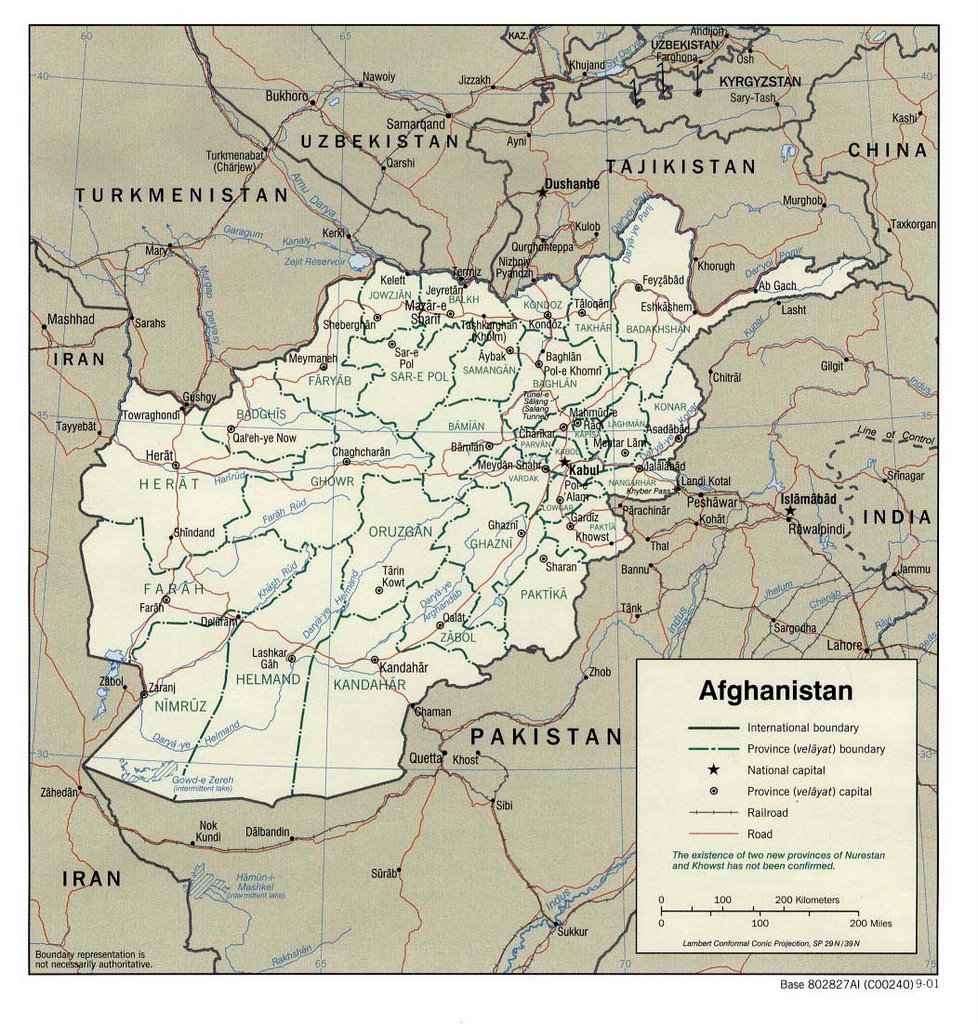
There never were any railroads to Afghanistan so the only way to get there before the late 50s was as part of an army. Then the U.S. and the Soviet Union built a road around the country. The U.S. built one from Herat on the Iranian border south and east to Khandahar and up to Kabul and the Soviets built one from Kabul up to Mazar-i-Sharif and then on to Herat. Basically it was the only paved road in the country and now, from what I understand, it is mostly unpaved... destroyed by decades of war and civil neglect.
I drove my van from Meshed in Iran to Herat. It was love at first sight-- mostly with the cheap, powerful hash and the Afghan people who were all stoned all the time. It always boggles my mind now how the mainstream media reports on the wars in Afghanistan but never mentions that every Afghan is stoned-- really stoned-- all the time. It probably has a significant effect on their way of fighting. Herat was like this magical medieval city, completely outside my realm of experience. And the next stop, Khandahar was even more bizarre, most strange, more mysterious and foreign. I felt like I was in Biblical times. Before going up to Kabul I visited some college friends who were in the Peace Corps, stationed in Ghazni. So primitive! But wonderful, warm, friendly generous people. They shared whatever they had.
I spent a lot of time in Kabul. Two Canadians who I had driven across Asia settled in to the one western hotel in the city, the brand new Intercontinental. It was a luxury high-rise in the middle of a basically mud city that looked like it would take a week of strong rain to just wash away. I'll never forget the Kabul River, more like a series of trickles and puddles in the middle of town. I recall standing near the royal palace, one of the few substantial buildings in the city, and looking down at the river. Men were on the bank brushing their teeth, washing their clothes, bathing, going to the bathroom, washing a donkey...

The other new thing in this ancient city that year was the Kabul Zoo. It was a wonder for the Afs... a little rinky-dink for the foreigners. But everyone was stoned and everyone was enjoying everything. Except the Kabul Runs. No one enjoys that-- much worse than Montezuma's Revenge. Up and down Chicken Street there were European and Australian hippies staying in cheap flop houses and sick with the Kabul Runs. The music was great and the hash was the best and the food was fine and everything was so cheap. And you'd sit around and talk with people who had come back from Bamyan and the Hindu Kush and Mazar and the Khyber Pass and figure out where you wanted to go next. The king was still in charge and the Russians hadn't invaded yet. I remember seeing some mullahs, straight from the countryside, outraged that 2 young women got out of a car unaccompanied-- albeit covered head to toe (with just a little grill for the eyes) in a chadris (what they call a burqa everywhere else). They spat all over them. The scene has stuck with me for all these decades.
UPDATE: NOT SO FAST
I slept in my van the whole time I was in Kabul in 1969 and in 1972. But friends of mine stayed at the Intercontinental, the only western style hotel in the
A thunderous explosion struck a 2-year-old Kabul luxury hotel frequented by foreigners on Monday, and the Taliban took responsibility, calling it a coordinated assault by four men armed with guns and suicide belts.
The Interior Ministry said at least six people were killed and at least six were wounded in the explosion at the Serena Hotel, including two foreign officials it did not identify... The Associated Press quoted an American who was exercising in the hotel gym as saying that she heard gunfire after the explosion, and saw a body and pools of blood in the lobby area and bullet marks in the gym area. She asked not to be identified for her safety. Ambulances and American troops in Humvees rushed to the hotel after attack, the A.P. reported.
Things are obviously deteriorating? You think so?
One Year On And Nothing's Any Better
This is a post from a western woman, a filmmaker, working in Kabul. It very much captures the Kabul I recall, only it's much worse. Is it a place you'd be interested in visiting? I recommend reading the whole thing at the link. Here are some excerpts:
Going out to dinner is always an interesting experience. Fully covered from head to toe and always paranoid about forgetting a headscarf (or having it slip off your head in the car) generally make the experience more worrisome than enjoyable. Add checkpoints and Afghan police to the mix, along with bone-shaking car rides (no paved roads) and you get the picture.
In New York and New Delhi, I savored going out; dressing up, wearing new jewelry, getting to try new restaurants before meeting friends at a local bar for a drink. I don’t miss these things in Afghanistan – I came here knowing full well that my social life would change drastically (after all, I could’ve just stayed in NYC or Delhi if that’s all I wanted). But what I didn’t expect to change was the very vocabulary of my behavior.
In other cities, I have never thought twice about the fact that I couldn’t enter places without ensuring that I wouldn’t mistakenly brush past a man, that I had to give all men the right of way, and that I wasn’t allowed to speak to strangers or look at other men in the face. In Kabul, I do.
My first weeks here were the most painful-- having to unlearn everything I had picked up in rambunctious, loud Delhi. In Kabul, I felt like as if I was a captive-- wrapped around the head with a scarf that acted as a leash that instructed me to behave in a certain way. My first week was a string of commands from my male, Afghan co-workers and crew, who for my sake taught me how to behave on the streets – “don’t laugh too loud,” “keep your hands hidden,” “don’t say things too loud,” “try and keep your chin down,” “stop walking like you own the street!” And the ever familiar, “wear your headscarf tighter, Anita-jaan, it is falling off!”
...Like all local women in the neighborhood, I can’t leave the house alone. People outside of Afghanistan are shocked to hear this – “but the Taliban have left, no?” Yes indeed, but the Taliban did not make these rules. Many of these rules were actually enforced and created during the time before the Taliban by warlords who, bloated with arms and cash from Pakistan and the US (in order to defeat the Russians), fractured the country.
After the Taliban were defeated, those same warlords were brought back into power by the US. The Karzai government resumes must read like a list charges at an international tribunal. The human rights’ violations are endless. And it is thanks to them (and not the Taliban) that I have to live in a capital city shuttered by extreme conservatism.
A male partner must accompany me at all times outside the house. This ranges from the chowkidor to my husband to friends. Sometimes my husband’s translator comes along, humming as he walks ahead expecting me to follow blindly. When I want to stop, I ask the shopkeeper a question-- usually the price of something – making sure I’m extra loud to ensure he has heard me, and will stop humming and hurry over to where I am.
He carries everything after I’m done shopping. Per his instructions, I shouldn’t carry anything since I’m a woman. By month three, I have learned to walk behind him, lift nothing and simply head home as quickly as I can. He is a Pashtun from the south and older than I am.
The same translator is puzzled when my husband asks me what I want for dinner or lunch. He looks at our exchanges quizzically. We look Indian to him, and yet behave so differently from the Indians he sees in the soap operas he and his family watch at home. In that world men and women are often just as conservative as the Afghans, with each gender culturally filling very different roles. The women are meant to be docile, devoted wives, while the female evildoers are the ones who break the mould and wreak havoc among the orderly. My husband and I don’t seem to even understand that we’re different genders. We speak as equals. This is clearly confusing.
In the end, we finish dinner and make our way home through the dark and quiet streets. We paid the bill in dollars. Price-wise it would amount to the same if I had dined out in New York City. “Restaurants for expats charge expat prices,” explained a friend when I first arrived, “make sure you always have enough cash.” On the way home, my housemate reminds me that we are paying for more than just plates of pasta – we pay for the experience of normalcy. Or the closest thing to normal at least. We both agree it wasn’t for the food at any rate. It wouldn’t survive a New Yorker or New Delhi-ite’s expectations of a good meal (for the price we paid). But tastes change once you’re living in Kabul.
The only meals I have coveted here have been home-cooked Afghan vegetarian dishes prepared by a friend’s mother. Seated on their living room floor, with huge slabs of naan to catch the oil and juices dripping from our fingers, I have devoured bowls of red kidney beans steamed with onions and tomatoes and spices with plates of eggplant slices sautéed with tomatoes and topped with a tangy yoghurt sauce.
Subscribe to:
Posts (Atom)


Follow Us
Were this world an endless plain, and by sailing eastward we could for ever reach new distances