Showing posts with label Guest Post. Show all posts

Richard Bangs: The Cayman Islands - Fifty Shades of Bay (Part 4)

Today we have our fourth, and final, installment of Richard Bang's series on the Cayman Islands, which I've been fortunate enough to share with everyone this week. Richard is the host of the PBS television show Adventures with a Purpose and as such is fortunate enough to visit some of the best destinations on the planet. Judging from his stories from the Cayman's, I'd say that Caribbean paradise fits into that category.

I hope you have enjoyed the series and I want to thank Richard for sharing with us.


The Cayman Islands: Fifty Shades of Bay
By Richard Bangs

Part 4 of 4 Parts 


It’s the final afternoon in paradise, and I head for Hell.

Hell, it turns out, is a flash in the road near West Bay, named for a swatch of spiky, tortured, black, ironshore that looks like midday in the garden of evil. There are just a few structures in Hell: a bar named Club Infernal; the Devil’s Den novelty shop, a post office where one can send a postcard from Hell; and the fire-red barn called The Devil’s Hangout, sporting Beelzebub on the side, and the devil on a sheet of plywood in front with a circular hole where the face should be.

After I park on the brimstone pavement, a man wearing a red cape, pointed horns, a sharply trimmed goatee, and carrying a three-pronged pitchfork, bounds over with an arsenal of greetings:

"How the hell are you?" “Hell of a nice day.” and "Where the hell you from?"

“From Los Angeles, City of Angels. How do you like living here?” I ask.

“It’s a hell of a place.”

“How’s the weather?”


“Hot as Hell. But living Hell is the best revenge”

“Who the hell are you?”

Turns out Satan is septuagenarian Ivan Farrington, who makes a living dishing out every hellish pun on earth. He bought the shop in 1987 when it was called, like so many other affairs in these islands, “Paradise.” But, he says, “My business went straight to Hell, so I renamed it the Devil’s Hangout.” Now he does brisk commerce selling satanic souvenirs-- t-shirts with slogans such as “I took your advice and came here in a hand basket,” as well as coffee mugs, spoons, bumper stickers, whelk shells, and postcards with every mal mot conceivable.

As I pay for a bottle of Scotch bonnet-based Hell sauce Ivan pulls out his calculator and says, "I was born on July 17, 1934." He taps the numbers '17, 7, and 34' into the calculator, turns it upside-down. It reads: "HELL!"

When he hands me change he snorts, "Thank you. Now get the hell out of here.” As I depart, I realize I’m made a wrong turn, ending up on Church road. So, I make the U-Turn, and once again pass through Ivan’s infernal town, so at least I can say, with all honesty, I’ve been to Hell and back.


---

So, what makes the Cayman Islands different? My undergraduate degree is in Sociology from Northwestern University, and I still pal around with sociologists, and some fret about constant e-mailers and texters losing the everyday connections to casual acquaintances or inconnus who may be sitting a touch away in the café or on the bus. That is the current dynamic in the continental U.S., in Europe, Asia and beyond; but not yet here. It could be said that we in the US are now, more than ever before, building barricades with our devices, employing screens that screen out strangers. Yes, they reinforce family and friends—we can chat and text and twitter with them more than ever—yet we are blocking the chance encounters, the random meetings, and with them the brushes against novel and unfamiliar perspectives, and the shivery flashes of insights. Cayman is different, and it disarms all who visit.

The Caymans Islands achieves a kind of correspondence between belief and place, between inner and outer landscapes, between travelers and locals, as all trace to somewhere else.

Caymanians talk to everyone. They look up at the clear sky. There is a dance to their tread. Adults become children as they swim with stingrays. Businesspeople walk to their appointments, greeting the people they see. Caymanians are connected to the sky and water and land, and, most of all, connected to one another, and to those who visit.

Wandering through the blades of sunlight along the paths of Cayman, witnessing the mastery of environmentalists and entrepreneurs, delving into the music, food, nature and culture, and basking in the welcomes of new acquaintances, I am knocked over with a feeling of being part of something deeply human and universal.

The paradox of the Cayman Islands is that it was a bleak, unwelcoming place that kept people away for much of its history; yet it became a place of gathering for modern questers, and as such, a locus for the exchange of fresh ideas, of fusions of food, song and the arts. It was once considered a Hell on earth, but it became Paradise. And it is today a milieu that transports identity and tolerance, romance and preservation; it unnerves habits and perceptions, unwinds the mind, sheds shells, and along the way leads to the loss of items not usually missed….pins and needles, taxing thoughts, and disquietude.

This is the treasure of the Cayman Islands.


Richard Bangs: The Cayman Islands - Fifty Shades of Bay (Part 3)

Today we have part three of the excellent series contributed by Richard Bangs of Adventures with a Purpose fame. Richard recently traveled to the beautiful Cayman Islands and he's been sharing his thoughts on that amazing place, which provides visitors with a mix of adventure, luxury and romance. Enjoy!

The Cayman Islands: Fifty Shades of Bay
By Richard Bangs


Part 3 of 4 Parts

Cayman Islands

The hours melt away as I snorkel the brilliant reefs, hike the filigreed interior, draw figures in the sand, collect lovely shells, even paddle around the island in a leaky plastic kayak. I finish reading my one book, Explorers of the Nile, and then stare at a palm tree. I come to admit I’m bored. All these studies about how continued connectedness leads to attention deficit disorder may be true. I’m restless, and anxious. I need a fix. It’s time to get back to civilization. So, I pull out my cell, and push the on-button. But nada. It’s out of juice. I panic. But then reach deeper into my pack, pull out an Energizer portable charger, plug it into the phone, and make the call. But it goes to a robot voice saying the mailbox is full; call again later. I’m castaway on a desert island.

So, I decide to swim for it. I stash my pack and sandals, towel, hat and sunglasses, and head into shark and jellyfish waters towards the shore of Little Cayman.

I make it, and after arranging for a pick-up of my left-behind gear and electronics, head to the Edward Bodden Airfield, and catch the first flight back to Grand Cayman, and then straight to Camana Bay, the new cosmopolitan development packed with so many high-end restaurants, glam shops and luxury labels some call it Brand Cayman.


I first stop at Books & Books, carrying the kind of collections the best Borders used to offer, and pick up several new titles, in case I’m stranded on a desert island again, or a hurricane hits. I step by the sports stadium, where the Rugby team “No Woman No Try” is practicing. I stop for a delightful meal at Ortanique, a Nuevo Latina Carib-Asian eatery. And I run into Kenneth Hydes, the VP of Product and Experiences, who tells me the billion dollar development is the brain child of Kenneth Dart, heir to the Dart Container Corporation of Michigan, world's largest manufacturer of foam cups. Kenneth gave up US Citizenship in 1994, moved to Cayman, becoming an investor, and a champion of recycling initiatives. His refined taste is represented in Camana Bay, which is more Rodeo Boulevard than Caribbean sugar shack, more Waterford and Cartier than watermelon and giclée, and it gives Cayman, already the most sophisticated stop in the region, an extra lift.

The perfumed tropic air is Sunday’s, and at the crack of noon I head out for the contrast to Camana Bay, the Grape Tree Café on the beach in Bodden Town with its locally-famous Sunday Fish Fry. This is where the islanders come, and bask in deep-fried bliss. “It humbles the stomach,” says Alex Bodden, related to the first settler on Cayman back in 1700, and who owns, with his family, the adjacent Texaco gas station and liquor store. The perfect combination platter. The café itself is the size of breadfruit basket, and sizzling away inside are chunks of snapper, mahi, wahoo, swai, chicharrón, as well as conch fritters, plantains, cassava, and sweet potatoes, all for a fraction the price of the fusion appetizers at the resort hotels and trendier west end eateries. And outside, around thatch-roofed tables, an array of well-nourished Caymanians sit and nosh, swap stories and jokes, and generally enjoy the island life and food.


After lunch I’m hungering for some island music, so head over to Hopscotch Studios, where the Swanky Kitchen Band is in full practice mode for an upcoming wedding performance.

It’s an incredibly energized jam—it’s music that softens rock, and could bend the ironwood tree. Between takes I chat with the electric violinist Samuel Rose, the leader. He explains that “swanky” is a Cayman word for lemonade (made with brown cane sugar), and that Cayman kitchen music represents the melting pot that is Cayman, tracing influences back to Irish fiddling and Scottish jig traditions, mixed with African slave rhythms. Then it blends in ostinatos of calypso, reggae and jazz.
“In the old days the kitchen, or caboose as we call it, was the center of Caymanian homes, a detached room in the back where everyone gathered, and so it became a natural place to socialize, celebrate, dance and create music, using cassava graters and other kitchen utensils. We’ve picked up on that tradition, and are carrying it forward with our own signature.” But Samuel doesn’t want to jab too long; he wants to skank, and I’m not suffering from an overabundance of good sensations, so I step to the back of the room, pick up my feet in terpsichorean splendor, and surrender to the swank.


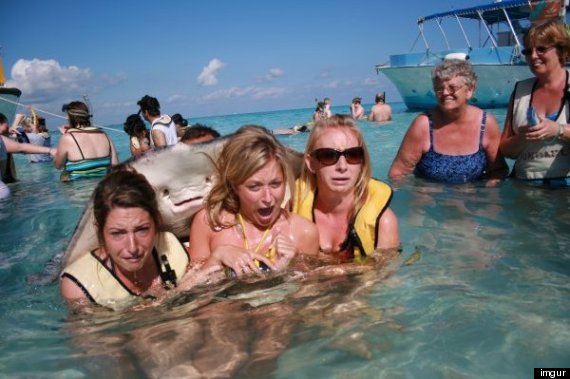
A photobomb went viral recently, three women in midst of a vacation photo pose being hugged from behind by a pin-eyed stingray:


So, this final soft-blue morning I catch a fishing boat named Heavenly Hooker and head out to find the scene of the slime. We cruise out to a shallow bank in the North Sound, drop anchor, and beneath crystalline waters see a dozen gray-hued underwater bats, the size of pterodactyls, gracefully circulating at our stern. Captain Stacy leaps into the waist-deep brine with a bucket of smelly squid. Immediately the rays lap him, coddle him; cats to catnip. The captain motions me to join, but I’m a bit hesitant, remembering too well Steve Irwin’s untimely death by stingray barb in the Great Barrier Reef.

But what good is travel without a little fear? So, I take the leap, and though my mind is trembling on the edge of danger, the soft Portobello mushroom skin of the rays against my own is rather silky and sensuous. It is an agreeable kind of horror.

This interspecies dynamic came about some years ago when fishermen, to avoid the once mosquito infested coastlines (so bad it was, they say, the mosquitos could suck a cow to bloodless death), started cleaning their catch in this calm off-shore channel, and the Atlantic Southern stingrays gathered to nibble at the gut scraps. Soon the stingrays began to associate the sound of a boat motor with food. Now, it’s a daily ritual, and the wild rays have gone gentle, gliding about torsos, through splayed legs, planting hickies on exposed human skin while suckling for food, and wrapping wings around their guests in puppy-like hugs, all in symbiotic exchange for morsels of sea meat. “Oh, it feels good to be touched by a stingray,” beams Captain Stacey. It is undeniably, ahem, a raydiant experience.