Showing posts with label Tourism. Show all posts

Tourist Attractions Galore (US only) at HappyMappy.com


As a geographer, I have a bias toward mapping applications that relate to Web 2.0 and Travel 2.0. So even though I get a lot of links to Travel 2.0 websites in my inbox, and even though I really should be reading student term papers right now, I did mention this new site (still in beta), in part because of its simplicity and mostly because of it potential usefulness for travelers in the US.

HappyMappy.com is a map of tourist attractions in the US. (Sorry, rest of the world.) Attractions include: "history, arts, recreation, nature, science, parks, sports, theater, concerts, nightlife & activities." It is basically a mash-up of Google Maps and Yahoo! Local, with some added information and functionality. At each zoom level HappyMappy will show up to 100 of the most popular attractions. It is unclear just how popularity is determined.

Checking the attractions around Flagstaff, Arizona, I found the results to be quite comprehensive, and there were a couple of items listed that I was personally not aware of. It was not perfect, however, as it included a couple of motels (not really tourist attractions) and places on the Northern Arizona University campus that I thought were a bit questionable. For example, the Du Bois Center is tagged with: Concert Entertainment Live Entertainment Live Music Music Nightlife Venue. However, it is mostly a food outlet for students and a conference center with meeting rooms and an auditorium that may, on a very infrequent occasion, have some evening event that is open to the public. In addition, as student recreation center is listed that is not open to the public.

In addition, downtown Flagstaff, especially on Route 66 (US Highway 89/180), has a lot of tourist arts/gifts/souvenir shops, but only a couple are listed. And I wonder how well they will be able to keep this information current given the relatively high business turnover in this sector. Finally, urban districts and scenic landscapes are attractions, as well. But these do not show up on the HappyMappy maps. While it might be possible to identify downtown Flagstaff as a tourism hot spot, based on the large number of pin points there, the historic hotels along Route 66 as not so well identifiable.

Also, I was not able to save my points of interest and maps either in Firefox 3 (beta) or on IE 7 after I registered on the site. I would think this kind of problem would be mostly resolved in a beta release, but I guess not this time.

HappyMappy reminds me of VeniVidiWiki.eu - which is a pin map showing links to tourist attractions around the world, but which also emphasizes videos and photos more, and text descriptions of the attractions less than does HappyMappy. VeniVidiWiki also allows users to add additional sites to their database, though there is no social networking related to that. And there is also Simpatigo.com which links the attractions to an itinerary route -- though that makes it more complicated, as well. I covered VeniVidiWiki.eu before here and Simpatigo.com before here.

From Tourist to Traveler - Educating visitors about Angkor Wat


A friend of mine, Tim Winter, sent me a link to his new website about travel, tourism and heritage in Cambodia, with an emphasis on Angkor Wat <http://www.postconflictheritage.com>. The website is essentially intended to support and expand upon his recent book on the same topic, which can be found on the website. The site also includes links to recent news stories related to tourism and heritage issues in Cambodia.

While a lot of Web 2.0 tends to focus on practical tools for organizing trips and finding the best deals from insiders. At best, they provide users with information on must see attractions.

However, tourists are part of the tourism economy -- which is generally considered the largest part of the global service economy, and has huge impacts on host destinations. Few tourists fully understand their role in this tourism economy, and how they are shaping and changing the destinations that they visit.

Website like this one on Cambodia help to bridge this gap between being a leisure tourist and an aware traveler. Good job, Tim!

What is Travel 3.0 ?

From the many podcasts that I listen to, I have basically heard of two definitions for Web 3.0:
  1. Web-Everywhere Technology - Always connected portable technology
  2. Total Immersion Web - Virtual worlds and MMOGs
Web 1.0 was the static, expert knowledge web. Web 2.0 is the interactive, user knowledge web. So these definitions of Web 3.0 as an always connected technology and total environment knowledge web make sense to me.

And either way, the significance for travel and tourism is enormous. An everywhere web is a traveling web. It means being connected when you travel locally to work, to the grocery store, to the gym, as well as on business trips and family holidays. The Web 2.0 tools that I review on this website are among the leaders into this everywhere web space, which I predict will move toward greater convergence in the coming decades.

I have personally not bought into the the Second Life virtual world phenomenon, which I think is far from ready for prime time. In the long run, however, I think that online virtual worlds will become an important way of communicating with other people, initially, and with distant environments, ultimately. The newly emerging Web 2.0 sites that have video tours of hotels and destination are important baby steps in this directions -- even more so than the experimental hotel building in Second Life because they are more accessible for the masses.

Travel 3.0 is clearly not here, yet. However, because we can conceptualize it -- imagine what it will be like -- it is an important force shaping the visions of todays Travel 2.0 engineers and entrepreneurs.

----------
UPDATE:
Check out the Sunverse.net blog, which is "All about Virtual Worlds and the Tourism Industry". The site mostly focuses on the development of real world tourism destinations in Second Life.

UPDATE: March 26, 2008: Bill Ryan, heard on Kenradio.com : "Web 2.0" was setting interoperability standards (including AJAX and web services, etc.) and creating communities and user-generated content. Web 2.0 was very exploitative of user generated content. "Web 3.0" is engaging more professionals to create user-generated data/content communities by compensating them. Also the semanitic web as the new tech-side supporting the new communities.

What would this mean for the travel and tourism industry? I am not sure. As an academic working on a couple of textbooks during my sabbatical, I think it is involving other academics who may adopt my books to create teaching and learning communities that provide value both for the teachers, students and the world at large. I had not thought about the potential role of compensation -- but am considering it now. I will be working on this over the summer.
------

(Originally posted on my Web 2.0 Travel Tools Blog - Alan A. Lew)


Blogging in the Tourism Academy

I recently sent out a question to some 1000 or so tourism academics (professors, lecturers, graduate students, and other researchers) on email discussion lists, asking them "Do You Blog?" The purpose was to see how blogging is used by tourism academics. A summary of my findings can be found here:

http://tourismplace.blogspot.com/2007/05/why-dont-we-blog-university-faculty.html

The major categories or types of blogs that people told me about include:
  • Blogging about Tourism
  • Blogging for Classes and Students
  • Research (and) Blogs
  • Personal Travel Blogs
  • Podcast Blogs
  • Email Lists as Blogs
Click the link above for details. I have been updating these as new blogs are brought to my attention.

VeniVidiWiki -- Wiki Map Travel Guide


VeniVidiWiki: travel guide

VeniVidiWiki.eu is a Google map wiki mashup for attractions around the world. Anyone can add a POI (point of interest) to the map and provide as much as possible of the following information:
  • Name of place/poi
  • Category - those shown above are listed as POI with Video -- so they all have a video link; the full list of categories is listed on the left
  • Description
  • Website, and
  • Photo and/or Video links
The wiki has a large number of sites, and crashed a few times when I was trying to view a lot of them. But in general it is quick and easy to navigate, and worth exploring to learn more about attractions in a place you may want to visit.


Step Up Travel - Sustainable Travel Does Web 2.0


"We promote responsible travel which emphasizes the importance of personal exchanges, deeper cultural understanding, genuine benefit to local people and their communities, preservation of the environment, and ultimately a more peaceful and equitable world."

Step Up Travel claims to be the first application of Web 2.0 to Responsible Travel, and I think they may be right. There are older websites devoted to responsible travel, including both resources on responsible travel issues and listings of responsible tour products. Two that I am familiar with are Planeta.com and the Big Volcano Ecotourism Centre. But both of these are in need of a major Web 2.0 face lift. And there is the National Geographic Center for Sustainable Destinations, which is sometimes related to the more commercial National Geographic Traveler. As colorful and engaging as National Geographic is, however, it lacks a social interface and comes across as more institutional and less in touch with the "real" people in a destination.

So I think, yes, Step Up Travel is the first responsible travel site on the Web 2.0 era:
  • It has an attractive and clean interface,
  • it provides resources to help make travel more responsible,
  • it appears to be making a concerted effort to market truly local products that support the destination, and
  • it has a Travel Network for "Socially-minded Travelers to Connect with local people, Get off the beaten path, and Change the face of travel."
The Travel Network will be the real test of the success of Step Up Travel in achieving its goals of linking local people with concerned and responsible tourists. I have joined and it is successful.


Reactive: Web 2.0 for Travel and Tourism


Reactive, a UK and Australia-based web design agency, has released a free "white paper" titled Web 2.0 for Travel and Tourism. The white paper is a good summary of different aspects of Web 2.0 and examples of companies and websites that are using them. Each category (listed below) is discussed in three sections: (1) Basics, (2) How does it relate to the tourism and travel industry?, and (3) Examples. The major Web 2.0 categories are (from their blog):
  • Blogging (Starwood, Eurostar and STA Travel)
  • Podcasting (Lonely Planet, Orbitz, Virgin Atlantic, The Independent and Heartbeat guides)
  • Social networking and user generated content (TripAdvisor, Yahoo, Contiki and Sheraton)
  • Online video (YouTube, Travelistic and MGM Grand Las Vegas)
  • RSS (Expedia, STA Travel, Virgin Holidays, Orbitz, and Conde Nast)
  • Tagging (del.icio.us, Flickr and Travbuddy)
  • Mash-ups and Open API’s (Locale, Virtual Tourism, Blogabond, 43 Places and TripAdvisor)
  • Wikis (Wikitravel, World66 and TripAdvisor)
  • AJAX (Kayak, Sidestep, Farecast and Google Maps)
You can request a copy of the white paper (.PDF) file from Reactive's blog.

Tourism and Social Media Class at NAU

I have added Social Media to my Spring 2007 class, "Planning for Sustainable Tourism". The class is taught 100% online. Hopefully I will not overwhelm the more technologically challenged students in the class! Click on the title above to go to the current version of the class overview. Registration information can be NAU Distance Learning.

OVERVIEW of PL 376 for Spring 2007
- January 16 - May 11, 2007

Click here for Syllabus

Topic Groups: Each student will be assigned to one of the following three groups at the start of the semester. Students will be given the opportunity to switch groups later in the semester. The Final Project will be related to the topic of the group. A couple of sample topics for each group is shown below.

  1. Sustainable Tourism and Money
    • Promoting Destinations and Sustainability Online
    • Monetizing Sustainable Travel and Tourism Websites, Blogs and Podcasts
  2. Sustainable Tourism and the Environment
    • Social Networking for the Environment
    • Online Environmental Education
  3. Sustainable Tourism and Community (Physical and Digital)
    • Online Citizen Participation / Political Activism
    • Virtual Communities and Real Communities

CLASS SCHEDULE - Please See the LEARNING MODULES and CALENDAR for Actual Assignments and Due Dates

This Schedule is Under Construction, though it will probably not change much.

Week
Points
Module 1 - Intro to Class, Sustainability, and Social Media
1-2
Class Intro Assignment: Tourism Development Issues
75
3
Sustainable Development and Tourism
75
4
Social Media and Tourism
75
5
Planners and Planning for Tourism
75
6
Sustainable Tourism, Planning and Social Media
75
7
Midterm Exam #1
100
Module 2 - Tourism Impacts (using collaborative blogs)
8
Economic Impacts of Tourism
75
9
Social Impacts of Tourism
75
10
Environmental Impacts of (and on) Tourism
75
11
Topic Group Wiki Projects: Resources for Manging Tourism Impacts, Greening the Tourism Economy, or Tourism Planning for People
75
12
75
13
Midterm Exam #2
100
Module 3 - Social Media and Destination Marketing
14
Final Project: Place Promotion with Social Media (website creation, podcasting, and other Web 2.0 Travel Tools; there is no final exam)
75
15
75
16
100

Total Points (subject to change)
1200

Definitions: Social Media - Social Software - New Media

Social Software Tools that will be used in this class, include:

  • Message/Discussion Boards (we will use this in Blackboard-Vista)
  • Websites (this will be part of the final project, most student will use the simple online web creator at Weebly.com, or the free domain service from Microsoft Live)
  • Wikis (at a minimum, there will be one wiki for each of the Topic Groups above)
  • Social Bookmarking (e.g., Del.icio.us - optional)
  • Blogs (potentially including video and photo blogging; at a minimum there will be one collaborative group blog for each of the three Topic Groups above)
  • Podcasts ( this will be part of Final Project, and if it is good enough I will put it out on my Geography for Travelers podcast - with your permission, of course; this will also be shared with student at the University of Victoria in Melbourne, Australia)
  • Virtual Reality (optional; can you promote a destination through Second Life? want to try?)
  • Social Networks (all students will be required to join and report on a travel-related social network)


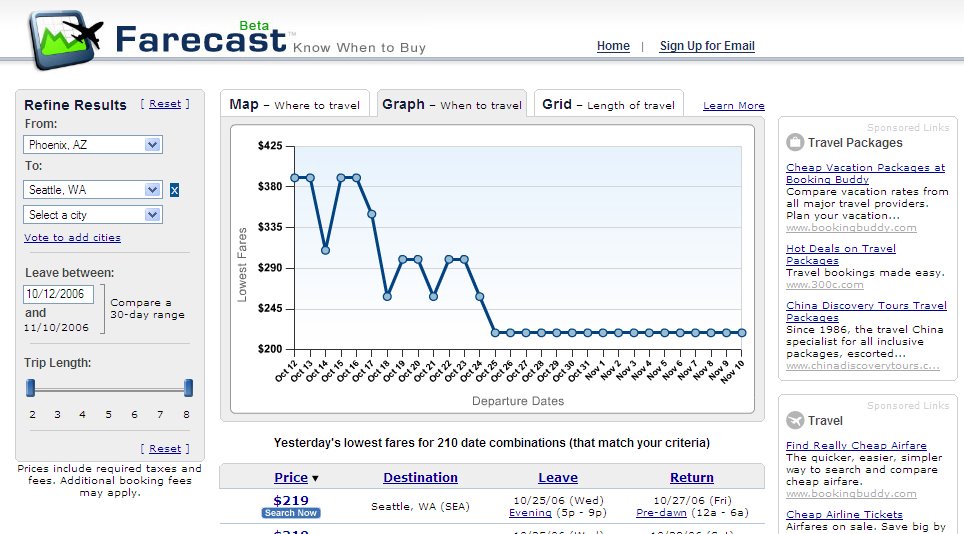
Farecast Expands to 75 Cities


Farecast is now available to for 75 cities! The website that predicts the best air fare prices on a given day based on historical data was previously only available for Boston and Seattle.

Farecast is basically an airline fare search engine. I am not sure just how good it is at that, and suggest that you compare it to your current favorites before you buy anything. What Farecast offers that is unique is a tool that tries to predict when the lowest prices can be found between any two cities. Unfortunately it appears that this tool only works for flights between the 75 cities that are in its database. I could not get a price on a flight between Phoenix and Fairbanks, for example, because Fairbanks is not in its database.

However, this is a big move up from the original two cities that previously made the site a curiosity, but not very useful. The intend to continue to grow the database, and I will look forward to the day when they also add international cities!

iAudioguide.com & Other Podcast Walking Tours

I recently received an email from Torsten Peters at iAudioguide.com with updated information about their free downloadable audio walking tours, which currently cover London, Barcelona, and Paris. Interestingly, he included a couple of competitor urls and told me that if I wanted more he would send them. I said yes, and boy was I surprised at the number of links he sent me. At some point, when I have some free time (ha!), I will write a review article on this topic, possibly for my journal, Tourism Geographies. But in the meantime, I wanted to share the links with all of you. Torsten noted that iAudioguide.com is free, while most of the others charge a fee for their downloads. If you know of any others that I should add to this list, send them to me (travelgeographer@gmail.com) and I will add them to this list.

Thanks to Torsten!

BTW - What should we be calling these? Auidoguides? Audiotours? Podguides? Podtours? ??

www.iAudioguide.com
www.soundtrek.org/ - Bangkok
www.podguides.net
www.parisaudioguides.com
www.bluebrolly.co.uk
www.dorlingkindersley-uk.co.uk/static/cs/uk/11/travel/podcast.html
www.visitscotland.com/sitewide/edinburghpodcast
www.talkingstreet.com/
www.footnotesaudiowalks.co.uk/
www.audiocitytour.com/
www.ijourneys.com/
www.ricksteves.com/news/travelnews/0602/audiotour.htm
NEW: Passport Guides for the PSP: http://psppassport.com/

related articles
www.nationalgeographic.com/traveler/resources/st_travelswithipod0604/ipod.html
technology.guardian.co.uk/news/story/0,16559,1681516,00.html
www.nytimes.com/2005/05/28/arts/design/28podc.html?ex=1274932800&en=db1ced6873dcc4b6&ei=5090&partner=rssuserland&emc=rss
www.macnewsworld.com/story/50096.html
www.csmonitor.com/2006/0412/p13s01-litr.html
www.wired.com/news/wireless/0,1382,65945,00.html
tech.monstersandcritics.com/news/article_1089780.php/Portable_tourist_guides_now_in_service