Showing posts with label Wildlife. Show all posts
Video: The Seal Of Approval For GoPro
Yesterday we saw a curious cheetah interacting with a GoPro camera, today its some playful seals. If this video doesn't put a smile on your face, we should probably check you for a pulse. This was shot near the Farne Islands off the coast of Northumbria in England where the seal pups seem to enjoy chasing people.
Seal of Approval from Jason Neilus on Vimeo.
Australian Scientists Explore Lost World For First Time

Once inside the cape, the team determined that the entire region, which is encircled by impenetrable mountains, is 9 miles (14 km) long and roughly 3 miles (5 km) across. The region contains remnants of a rainforest left over from Gondwana, a reference to an ancient super-continent that existed millions of years ago. They also discovered a variety of new species as well, including three very unique reptiles. Those species included a new frog that lives under boulders and is capable of hatching its eggs without water and a skink that hunts insects by leaping from rock to rock. A third species was the most impressive however, an odd looking gecko that is unlike anything anyone had seen before.
The initial expedition to explore Cape Melville lasted just four days with the team seeing less than a tenth of the area contained there. The group is already planning a return trip to plumb further into the depths of the region to see what else they can find. The team believes that considering what they discovered in just a preliminary scouting mission, they could find some really unique species of birds, plants and even mammals once they really get the opportunity to check out the forests there. Considering that the Cape has been evolving on its own, almost completely cut off from the rest of the world for millennia, there could be some very unique creatures just waiting to be discovered.
These store always fascinate me. I love that our world is so vast that we still don't have regions to explore, even in the age of satellite mapping, GPS navigation and instant communications. It must have been a humbling experience for these scientists to become the first humans to step into this lost world and lay eyes on the wonders there for the first time. What an amazing world we live in.
Video: Cheetah Licks A GoPro
The title of this post pretty much says it all. Safari guide Matthew Copham set his GoPro camera down while out in the field and he managed to capture a once in a lifetime shot. A curious cheetah wandered up to take a look at the strange device and then gave it a lick. Fortunately, the big cat didn't find the camera tasty enough to eat. Still, pretty cool footage none the less.
Video: Richard Bangs Swims With Whale Sharks
Our friend Richard Bangs of Adventures with Purpose fame has shared a wonderful video with us today. It was shot off the coast of Cancun where Richard had the opportunity to go swimming with whale sharks, something he describes as the underwater equivalent of going on safari. This looks like an amazing experience and one that has now been added to my bucket list. Really amazing stuff.
5000 Mile Project: Couple Running The Length Of South America
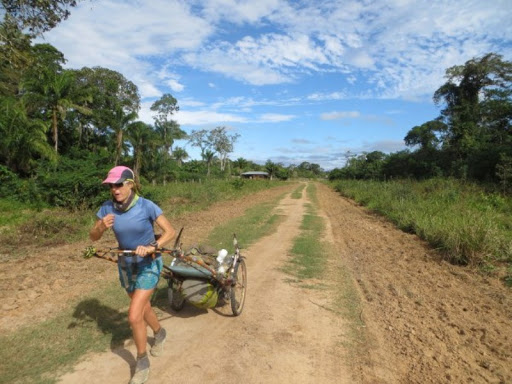
The began their epic adventure last month by setting off from Punta Arenas, Chile, the southernmost settlement in South America. They'll now work their way north through Patagonia, crossing between Chile and Argentina as they go. Eventually they'll cross into Bolivia before continuing on to Brazil, where they'll face one of the biggest challenges to the expedition – a crossing of the Amazon Rainforest. If successful there, they'll emerge into Venezuela and finish the journey with a run to the Caribbean coast.
The Lowrie's hope to wrap up their journey approximately a year after they started. That seems rather ambitious considering the difficult miles that lie ahead. The couple aren't just out on the road running unencumbered. They're pulling specially designed carts behind them that carry all of their gear and supplies as well. David and Katharine are hoping to cover roughly the length of a marathon each day (26.2 miles/42.1 km), which is a challenge but highly feasible while on roads. But once they hit the Amazon, things will be completely different and much more difficult in general.
The husband and wife team have undertaken the 5000 Mile Project to raise funds for Asociacion Armonia, BirdLife International and Conservacion Patagonica. The hope is to collect enough money to help fund the purchase of threatened habitats in South America to protect the wildlife that lives there. As part of the project, they are also recording the various animals they see along their run including the many bird species that inhabit the continent.
Their efforts don't end there however. They've also launched the BigToe Classroom which contains lesson plans and projects for teachers to use with their students to get them engaged with conservation projects as well. There is even a way to contact David and Katharine and set up a video conference call with them directly from the road.
You can learn more about the 5000 Mile Project in an interview that the couple did with Explorers Web earlier in the week. You can also follow along with David and Katharine's blog or on Twitter and Facebook.
Video: What Happens In Nature When We're Not Around?
Have you ever wondered what goes on in the wilderness when we're not there to watch? The video below will give you a little insight. It was shot by a wildlife camera stationed in Kananaskis Country located in Alberta, Canada. It starts off relatively simple enough. A bear wanders by and later a deer. After that another bear takes a liking to one of the trees, which serves as a great scratching post. But about 55 seconds in a bear party breaks out around that same tree that is simply comical to watch. Funny stuff for sure and will likely put a smile on your face.
Thanks to The Goat for sharing this one.
Thanks to The Goat for sharing this one.
Video: Whales Nearly Have Divers For Lunch!
If you thought that video of the flash floods that I posted earlier was scary, have a look at this one. It features a couple of divers in the water amongst a school of sardines, which just happen to be a popular snack for humpback whales. Near the end of the video a pair of the 40-ton beasts spring out of the water, narrowly missing one of the divers.
Warning: Some of the language may not be suitable for youngsters, but I'd be reacting in exactly the same way. Whoa!
Thanks to Outside Online for sharing.
Warning: Some of the language may not be suitable for youngsters, but I'd be reacting in exactly the same way. Whoa!
Thanks to Outside Online for sharing.
bigblueproject: Face To Face With An Elephant On A South African Road

Burkhard kindly asked me to submit a story back when bbp was still in its conceptual stages, but I had a difficult time finding an opportunity to put something together. He circled back around a few months ago and asked me for a submission again, and this time I could really see what he was building and quite frankly I was very impressed. I loved the concept and the stories and images that people were sharing were excellent.
Of course, now I was excited to be a part of the project but still had a difficult time finding a spare moment to put something together. Yesterday, Burkhard nudged me once again and having a bit of a lull in my schedule at the moment, I went to work on getting something together. He's already posted my photo and story today, which you'll find by clicking here.
My contribution to bigblueproject involves a run in I had with a big bull elephant while visiting Kruger National Park in South Africa a few years back. The massive creature was wandering down the center of one of the main roads and was none to happy to come across the minivan that I was riding in along with a group of other writers and our guide. If you've ever been in a vehicle that has been charged by a full grown male elephant, who happens to be looking for a girlfriend, you'll understand.
Anyway. I hope you enjoy the story and the bigblueproject.
Video: In Search Of Whales
The video below is remarkable for two reasons. First, it shows off the amazing DeepFlight submersible vehicle, which looks like it would be fantastic to cruise around in and secondly it gives us some great underwater video footage of whales. The DeepFlight was armed with an array of GoPro cameras on this outing and as a result, we get some great shots from under the sea. It's a bit long, but stick with it and the payoff is worth it. Enjoy!
Harrowing Tales Of The First Descent Of The Baro River In Ethiopia

In a recent post to his website, Richard shares some harrowing tales of his adventures along the Baro, which runs for approximately 306 km (190 miles) before it feeds into the Sobat River and eventually the White Nile. His stories include encounters with man-eating crocodiles, incredible white water and unexpected tumbles over waterfalls. The title of the article is "What's Worse? Death by Drowning or Crocodile" which pretty much tells you everything you need to know about this expedition. The article is a reminder of just how wild and untamed parts of our planet remain and how dangerous these expeditions can be. Definitely an excellent read for a variety of reason, as it touches on why we pursue dangerous adventures in the first place.
The video below serves as a bit of teaser for the story, but be warned, the footage is not for the faint of heart. There are some graphic images shown that some could find disturbing. If you'd rather avoid those images as best you can, I'd suggesting simply reading the article instead, although it also has a photo or two that aren't for the squeamish.
Explorers Club Establishes Award Honoring "Wild Kingdom" Hosts

2013 marks the 50th anniversary of the Wild Kingdom and to commemorate the series which became an American cultural touchstone, The Explorers Club has created the new Marlin Perkins/Jim Fowler Lifetime Artist-in-Residence Award. This first edition of the award is being given to Anthony J. “Buddy” Obara for his years of work creating bronze wildlife sculptures, particularly for the outstanding St. Louis Zoo. That presentation is being made by the Explorers Club St. Louis chapter on Saturday, May 18 at the zoo, where the EC is also donating a new bronze statue of an emperor penguin that was created by Obara. Jim Fowler will be on hand at the celebration as well.
I'm sure there are more than few readers who are around my age and have fond memories of Wild Kingdom. I discovered quite a few of the classic episodes are actually on YouTube. Like the one below that features Perkins and Fowler reminiscing about some of their more favorite adventures over the years.
Video: A Close Encounter With Humpback Whales
I've been fortunate enough to have all kinds of amazing wildlife encounters in my travels, but I haven't yet gotten the opportunity to go whale spotting. I hope to change that in the future and videos like this one only help to make that more of a priority. It was shot with a GoPro camera (of course!) and while it is short, it captures some amazing underwater images of a pod humpback whales. Simply beautiful.
GoPro: Cruising with Humpback Whales from GoPro on Vimeo.
Video: First Ever Footage Of Baby Tigers In The Wild (Updated!)
Tigers are notoriously reclusive cats that have gotten rarer as their species has continued to shrink in numbers. But recently the BBC was able to capture the first ever footage of a mother tiger with her cubs in the wild. And just how exactly did they manage to do this after years of trying? Simple! They strapped cameras to elephants! It seems the pachyderms and big cats are not exactly mortal enemies, so the tigers don't flee when the elephants wander by. As a result, the BBC was lucky enough to capture this footage. Narration provided by Sir David Attenborough of course!
Update: It has been brought to my attention that this video is older than the February 15 posting date to YouTube and likely dates back to 2007. It was originally used in a BBC documentary entitled Tiger: Spy in the Jungle which was broadcasted in 2008. The footage is still remarkable and the story remains the same, but wanted to clarify that this isn't completely new after all.
Update: It has been brought to my attention that this video is older than the February 15 posting date to YouTube and likely dates back to 2007. It was originally used in a BBC documentary entitled Tiger: Spy in the Jungle which was broadcasted in 2008. The footage is still remarkable and the story remains the same, but wanted to clarify that this isn't completely new after all.
Video: Freediver Catches Ride On A Great White Shark
The woman in this video, the aptly named Ocean Ramsey, is most certainly braver than I am. Not only is she a freediver but she also seems to have no fear of sharks. Freedivers swim to impressive depths without the use of scuba gear and in this video she's doing just that when she decides to grab a passing great white shark to go for a ride. Despite the fact that she's flirting with one of the more impressive predators on the planet, the video is oddly tranquil to watch.
Thanks to the Goat for the recommendation.
Thanks to the Goat for the recommendation.
Video: Divers Have Close Encounter With Whale Pod
Whale watching is an incredible experience, giving us the opportunity to get up close and personal with some of the largest animals on the planet. But the divers in this video had a similar encounter while actually being in the water with the massive mammals. The footage was shot using a GoPro Hero 3 (what else?!?) off the coast of Maui and features some astounding shots of whales as seen from underwater.
Seriously, I need to get one of these GoPro cams already!
Seriously, I need to get one of these GoPro cams already!
Video: When Eagles Attack!
This video has really been making the rounds today, but in case anyone has missed it, it is a must see. It was shot in a park in Quebec and features a large golden eagle swooping down and actually picking up a small child. The first part of the video is at regular speed, so it's hard to see what's happening, particularly when the cameraman starts to panic. But wait for the second half of the video when it drops into slow-motion to really see what was going on. Crazy!
Edit: Okay, so I've been had. This video is a fake. I knew it had to be too good to be true. Still a fun video. And kudos to those who made it for pulling this off.
Edit: Okay, so I've been had. This video is a fake. I knew it had to be too good to be true. Still a fun video. And kudos to those who made it for pulling this off.
Video: Kayakers Have Close Encounter With Whale
One of the things I love about kayaking is how close it allows you to get to nature. Of course, at times that can mean getting a little too close to nature. Take for example the sea kayakers in the video below, who were paddling off the coast of Norway this past weekend when they came across a humpback whale. Just how close did they get? You'll have to watch the video to see for yourself, but lets just say it's closer than most of us would feel comfortable with. I also learned from this video that certain words are universal in meaning and pronunciation, no matter the language.
Tip of the hat to my friend Laurel over at Gadling for sharing this video earlier. Very nice find.
Tip of the hat to my friend Laurel over at Gadling for sharing this video earlier. Very nice find.
Subscribe to:
Posts (Atom)


Follow Us
Were this world an endless plain, and by sailing eastward we could for ever reach new distances