Back in August and September I posted a couple of time about the TitiKayak expedition. For those who don't recall, that was the attempt by Belgian adventurer Louis-Philippe Loncke and Peruvian explorer Gadiel "Cho" Sanchez Rivera to become the first people to circumnavigate Lake Titicaca by kayak. The lake, which is located at 3812 meters (12,507 ft) in altitude and falls along the border of Peru and Bolivia, covers an area of 8372 sq. km (3232 sq. miles) and is widely considered to be the highest navigable lake in the world. Lonke and Rivera set out to paddle 1100 km (683 miles) around Titicaca's parameter while taking photographs if its shoreline and GPS coordinates of its current position. The hope is that the data will allow researchers to study the impact of climate change on the lake in the years to come by having baseline numbers to compare their readings to.
The expedition actually wrapped up in late September but due to busy schedules and other commitments, it has taken a bit of time to upload the photos from their journey and share details of what it was like out on the water. All told, it took Lou-Phi and Cho 38 days to paddle around the lake, staying close to the shore for most of the way. Stopping frequently to take photos and gather GPS data, the two men were meticulous in their approach and stuck closely to their plan as much as they could. They did run into some issues when attempting to cross the border into Bolivia, as law enforcement at the checkpoint between the countries were reluctant to let them pass, in part because they had never seen a kayak before. It took two days to sort out the paperwork, but eventually it came together and the adventurers were allowed to continue on their way.
Dealing with immigration officers were the least of their worries however and there were plenty of other challenges to keep them on their toes. For starters, August and September are winter months in the Southern Hemisphere and this was one of the coldest winters in recent memories. The boys faced freezing temps for much of the way and the Puno region through which they traveled received its highest amount of snowfall in the past 30 years. Cold temperatures, snow and a big lake don't always make for the best of conditions.
The primary focus of the expedition was to not just paddle around its shores but to also survey the health of the body of water. What Loncke and Sanchez Rivera discovered is that Titicaca is facing some serious challenges. The water was littered with garbage and is contaminated by chemicals and sewage dumped into into it from the surrounding communities. In short, the lake faces some major issues in the future and with no regulation or proper water treatment in place, it is going to get much worse before it ever starts to get better.
You can read more about the expedition and the team's experiences on the TitiKayak blog. You can also review the photos they took along the way in their Photo Inventory. All of the images have been uploaded and organized, but GPS coordinates have not been matched to them just yet. That is a big job that will be completed sometime early next year, completing the full data set of the inventory.
Congrats to Lou-Phi and Cho on completing this amazing adventure. Great effort on both the exploration and environmental front.
Showing posts with label Bolivia. Show all posts
5000 Mile Project: Couple Running The Length Of South America
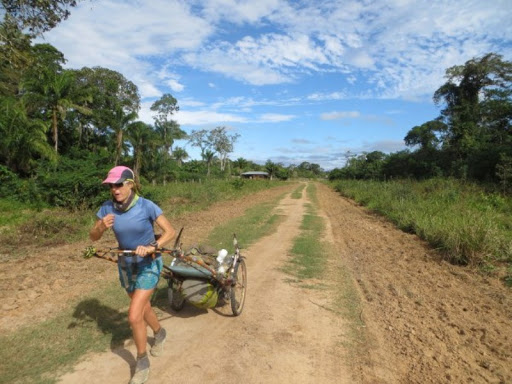
On July 28, David and Katharine Lowrie set out on a run like no other. The pair have hit the road to run the length of South America. Yes, you read that right. They are planning on running south to north across the entire continent and they're doing so to raise awareness and funds to protect the wildlife that lives in threatened areas there. Their expedition is aptly named the 5000 Mile Project, as that is the distance that they will cover before they are through. (That's roughly 8046 km for most of the world.)
The began their epic adventure last month by setting off from Punta Arenas, Chile, the southernmost settlement in South America. They'll now work their way north through Patagonia, crossing between Chile and Argentina as they go. Eventually they'll cross into Bolivia before continuing on to Brazil, where they'll face one of the biggest challenges to the expedition – a crossing of the Amazon Rainforest. If successful there, they'll emerge into Venezuela and finish the journey with a run to the Caribbean coast.
The Lowrie's hope to wrap up their journey approximately a year after they started. That seems rather ambitious considering the difficult miles that lie ahead. The couple aren't just out on the road running unencumbered. They're pulling specially designed carts behind them that carry all of their gear and supplies as well. David and Katharine are hoping to cover roughly the length of a marathon each day (26.2 miles/42.1 km), which is a challenge but highly feasible while on roads. But once they hit the Amazon, things will be completely different and much more difficult in general.
The husband and wife team have undertaken the 5000 Mile Project to raise funds for Asociacion Armonia, BirdLife International and Conservacion Patagonica. The hope is to collect enough money to help fund the purchase of threatened habitats in South America to protect the wildlife that lives there. As part of the project, they are also recording the various animals they see along their run including the many bird species that inhabit the continent.
Their efforts don't end there however. They've also launched the BigToe Classroom which contains lesson plans and projects for teachers to use with their students to get them engaged with conservation projects as well. There is even a way to contact David and Katharine and set up a video conference call with them directly from the road.
You can learn more about the 5000 Mile Project in an interview that the couple did with Explorers Web earlier in the week. You can also follow along with David and Katharine's blog or on Twitter and Facebook.
The began their epic adventure last month by setting off from Punta Arenas, Chile, the southernmost settlement in South America. They'll now work their way north through Patagonia, crossing between Chile and Argentina as they go. Eventually they'll cross into Bolivia before continuing on to Brazil, where they'll face one of the biggest challenges to the expedition – a crossing of the Amazon Rainforest. If successful there, they'll emerge into Venezuela and finish the journey with a run to the Caribbean coast.
The Lowrie's hope to wrap up their journey approximately a year after they started. That seems rather ambitious considering the difficult miles that lie ahead. The couple aren't just out on the road running unencumbered. They're pulling specially designed carts behind them that carry all of their gear and supplies as well. David and Katharine are hoping to cover roughly the length of a marathon each day (26.2 miles/42.1 km), which is a challenge but highly feasible while on roads. But once they hit the Amazon, things will be completely different and much more difficult in general.
The husband and wife team have undertaken the 5000 Mile Project to raise funds for Asociacion Armonia, BirdLife International and Conservacion Patagonica. The hope is to collect enough money to help fund the purchase of threatened habitats in South America to protect the wildlife that lives there. As part of the project, they are also recording the various animals they see along their run including the many bird species that inhabit the continent.
Their efforts don't end there however. They've also launched the BigToe Classroom which contains lesson plans and projects for teachers to use with their students to get them engaged with conservation projects as well. There is even a way to contact David and Katharine and set up a video conference call with them directly from the road.
You can learn more about the 5000 Mile Project in an interview that the couple did with Explorers Web earlier in the week. You can also follow along with David and Katharine's blog or on Twitter and Facebook.
Video: Experience Imagination In South America
To truly get a sense of South America, filmmakers Clemens Krüger, Vincent Urban & Stefan Templer traveled its length in a classic Land Rover, wandering through Argentina, Chile, Bolivia, Paraguay and Brazil. Along the way they captured some striking images from road and compiled them in the amazing video you'll find below. Those images are sometimes haunting, sometimes enchanting and always compelling. I hope you enjoy it as much as I did. Really beautiful footage.
Bolivia. A voyage to Bolivia, South America - Santa Cruz, El Alto, La Paz, Cochabamba, Sucre...
Simply superlative – this is Bolivia. It’s the hemisphere’s highest, most isolated and most rugged nation. It’s among the earth’s coldest, warmest, windiest and steamiest spots. It boasts among the driest, saltiest and swampiest natural landscapes in the world. Although the poorest country in South America (and boy do Bolivians get tired of hearing that), it’s also one of the richest in terms of natural resources. It’s also South America’s most indigenous country, with over 60% of the population claiming indigenous heritage, including Aymará, Quechua, Guaraní and over 30 other ethnic groups. Bolivia has it all…except, that is, for beaches.
This landlocked country boasts the soaring peaks of the Cordillera Real around Sorata and the hallucinogenic salt flats of Uyuni, the steamy jungles of the Amazon Basin and wildlife-rich grasslands of the Southeast. Unparalleled beauty is also reflected in its vibrant indigenous cultures, colonial cities such as Sucre and Potosí, and whispers of ancient civilizations. This is exactly what attracts visitors, and with good reason. Bolivia is now well and truly on travelers’ radars; opportunities for cultural and adventure activities and off-the-beaten-path exploration have exploded. But while most travelers stick to the well-worn paths of the Altiplano, there’s plenty to be found elsewhere, including the tropical east and the lowland regions in the south. Bolivia’s social and political fronts have been in flux since the appointment of the country’s first indigenous president. Optimism is generally high, especially among the indigenous majority, although many changes are afoot. Protests, marches and demonstrations are a perpetual part of the country’s mind-boggling landscape.
Subscribe to:
Posts (Atom)


Follow Us
Were this world an endless plain, and by sailing eastward we could for ever reach new distances